


Clusters of Interstellar matter
The agglomeration of stars, planets, interstellar dust, stellar remnants and other celestial bodies constitute a Galaxy.
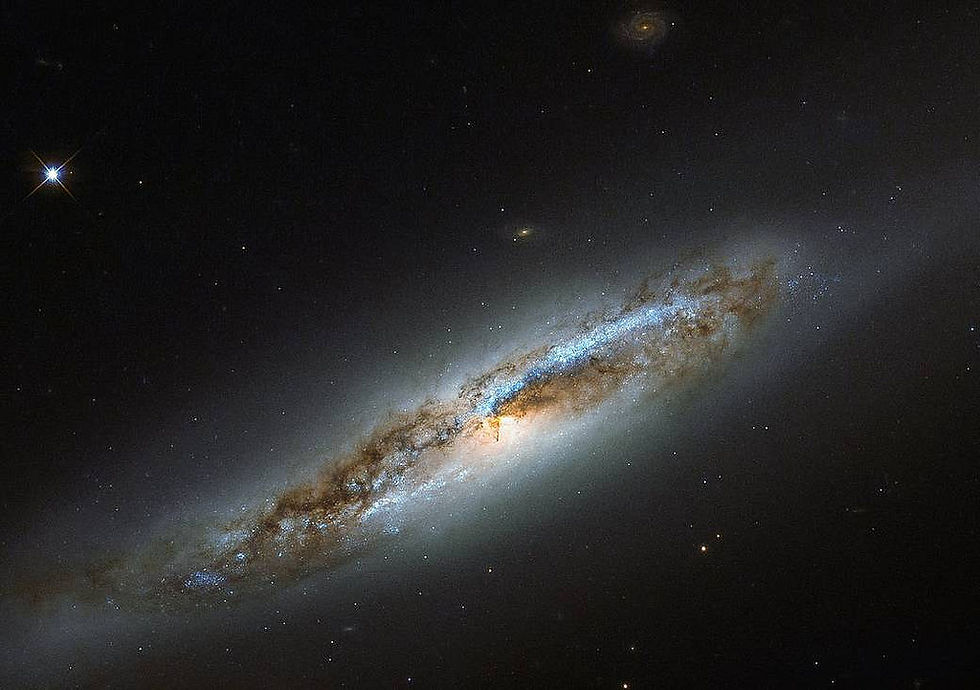
Galaxy, Credits, Wikimedia commons
About one billion years from the Big bang, the temperature of the universe subdued to 15 Kelvin, the atoms slowed down but still existed in high energized (ionized) state called Plasma. The first lightest elements, Hydrogen, Helium, Lithium, were created because of the interaction of elements. These elements due to inter Elemental fusion or capturing of neutron and proton (s&p-processes) resulted in the formation of heavier elements. This process is called Stellar Nucleosynthesis. Gravity led to the combining of these elements to a clump of matter, which led to the formation of massive structures called the Protostars. The Protostars were fiery celestial orb ancestors of stars that exist today. They have a region around them filled with dust and mineral-rich particles called protoplanetary disk which later gave birth to young planets. The primal stars along with their accretion disk wandered through the cosmos until it came into the gravitational influence of another Protostar. The Macrocosm of such stars along with stellar remnants and interstellar dust clustered together due to gravity, giving birth to the first galaxies. Edwin Hubble, an American Extragalactic Astronomer, classified the galaxies on based on their appearance. His prominent model was called Hubble-Tuning fork classification. This was further extended by Gérard de Vaucouleurs, a French Astronomer.

The Hubble tuning fork, Credits, Wikimedia commons
The Hubble System It has three broad categories, Elliptical, Spiral, Lenticular.
There is a separate category for galaxies with no distinct shape, smaller and have abundant gas and dust, called the irregular galaxies like Magellanic clouds and Ring Galaxy which have large amount of young hot stars ( mostly blue in color) and a central luminous region, for example Hoag's object and Cartwheel galaxy.

Hoag's object, Credits, Wikimedia commons

Cartwheel galaxy, Credits, Wikimedia commons
Elliptical: Assigned from E0 to E7 on increasing order of elliptical shape. E0 is almost close to circular and E7 is an elongated ellipse. These galaxies have no bulge or nucleus at the center, but it's brighter than other parts of the galaxy. Some of these assemblages have black holes and Quasars at the center. They resemble the orbits of planets, possess no arms extending out. The intensity decreases from the center, highly flat dimension with a lesser interstellar medium. They mostly retain older stars and sustain the least production of stars. These galaxies possess a more excessive amount of stars in spherical orbits around the galactic center as satellites (Globular Clusters), tightly bound by gravity.

Sombrero Galaxy, Credits, Wikimedia commons
Spiral: They have a distinctive bulge or nucleus at the center.There are arms or spirals extending out from the galactic center to the edge of the galaxy. These are brightest of all other classifications and have active star formation due to a large constituent of stellar remnants. These are labeled from Sa to Sc, where Sa being the arms tightly wound around each other. Another type of Spiral Galaxy is called Barred spiral. These have the fewer bulges at the center as opposed to the former but incorporate bar like nucleus with the spiral extending out from either end. They labeled from SBa to SBc, and similar to the other kind SBa is tightly wound to center and SBc is loosely wound.

NGC 1300, Credits, Wikimedia commons

Whirlpool Galaxy, Credits, Wikimedia commons
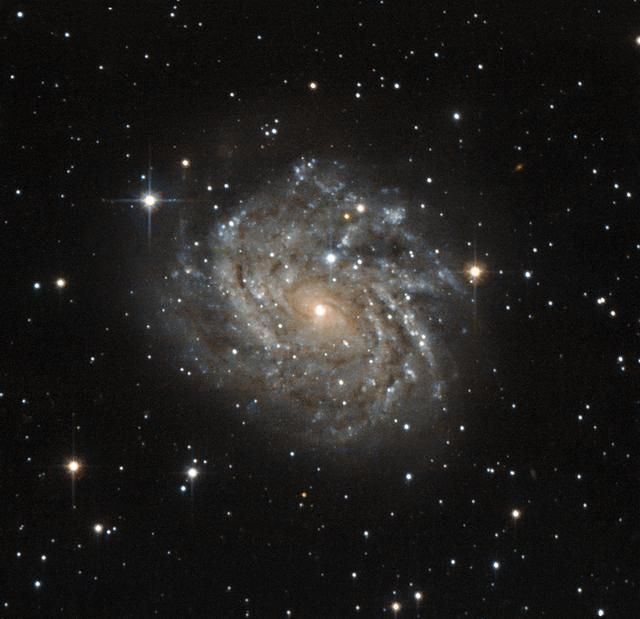
Pinwheel Galaxy, Credits, Wikimedia commons
Lenticular: Located at the fork of the tuning fork classification these galaxies are intermediate between an elliptical and a spiral galaxy. They have very little star formation and have an enormous amount of dust on their disk.They also have a higher disk to bulge ratio which makes it hard to distinguish from elliptical galaxies.
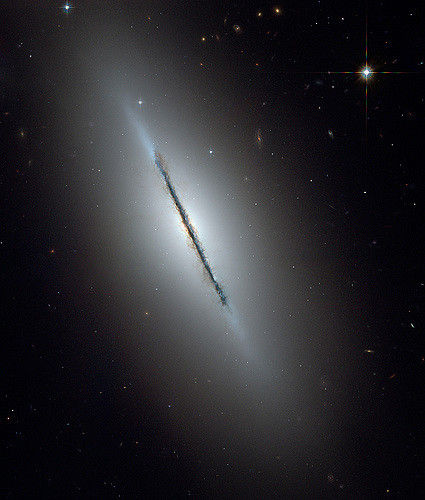
NGC 5866, Credits, Wikimedia commons
Seyfert galaxies are violent and fast moving elliptical active galaxies. They emit higher energy than a normal galaxy. They emit violent and huge jets of high energy radiation from their galactic center, thousands of light years into space. These are called Quasi-stellar objects or Quasar. A Blazar is a compact quasar along with supermassive black hole at the galactic center.

Quasar, Credits, Wikimedia commons
Our home galaxy is called the Milky way Galaxy which is a spiral galaxy. Nearest galactic neighbor is Andromeda which is 2.5 million light years from the Sun. Its predicted that after few billion years, these galaxies which are drifting closer to each other day by day, would collide with one another forming Antennae Galaxy. The galactic center is located 30000 light years from the Sun. Milky way galaxy is located in "Local Group" of galaxy, consisting of Andromeda, Triangulum galaxy and 51 other galaxies. Local group is located in massive concentration galaxies called The Virgo Super cluster, which is located in Local Super cluster.

Credits, Wikimedia commons



Comments